Yabby Burrows
The Narrow Road to the Deep NorthYabby Burrows is a soldier in Dorrigo Evans’s unit whose brief presence is preserved through two sharply different kinds of memory: a comic story from the campaign in the Middle East and the abrupt violence that ends his life in Syria. His nickname makes him a familiar figure in the group’s retellings; his death turns an ordinary breakfast into a measure of how quickly companionship can be broken.
Identity and Introduction
The available account gives little information about Yabby’s life beyond his place among the Australian soldiers serving with Dorrigo Evans. He appears through the shared stories of the men rather than through an extended individual history. They remember him as a comrade whose misadventures could be retold with affectionate exasperation, and as the person carrying their breakfast when the war abruptly reaches their position.
His nickname is tied to a story about a visit to a Cairo brothel. The joke turns on Yabby mistaking what he believed to be a nuisance acquired there for creatures from a toilet seat; the men later repeat the anecdote as part of their stock of campaign humor. The account does not establish more about his private life or character. What it does show is how a group’s nickname and recurring story can make an absent or endangered soldier present in conversation, reducing a frightening and unfamiliar experience to a tale that can be told again.
The Men’s Stories and Shared Memory
Yabby’s anecdote belongs to a broader body of stories through which the soldiers pass time and remember the campaign. In the Javanese highlands, prisoners look back on earlier experiences in the Middle East, and the tale of Yabby is among those that return. Their stories range from landscapes and encounters to boasts, jokes, and the remembered dead. Yabby’s episode is not presented as a major deed or a formal account of his service; it survives because it is repeatable and recognizable to his companions.
The men’s response to the story gives it a note beyond its humor. They conclude by pitying him as a poor, unfortunate fellow, a refrain that turns the joke into an expression of comradeship. The phrasing keeps affection and mockery together: Yabby can be the subject of a ridiculous anecdote and still be someone the group feels for. That mixture matters when the narrative later places his death among the same men. Their laughter has not made them immune to loss; rather, it has been one of the ways they have lived alongside danger and remembered one another.
The Shelling in Syria
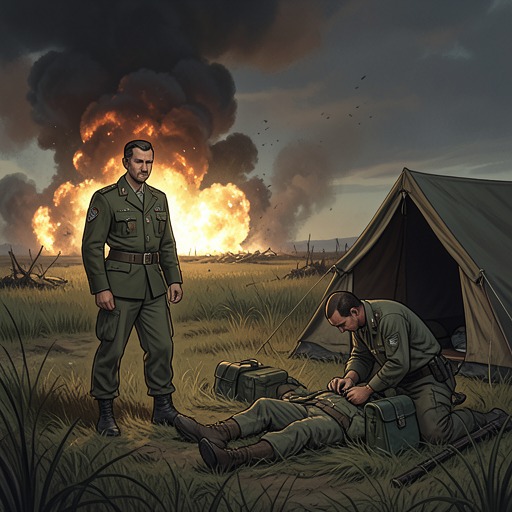
During the Syrian campaign, Yabby arrives from the field kitchen carrying a hotbox of breakfast while Dorrigo Evans is pouring coffee. A shell strikes their position. Darky Gardiner pulls Dorrigo down by the arm, and the blast passes through the group. When Dorrigo looks around, the blue armchair beside him has disappeared. Amid the dust, an Arab boy stands; the soldiers call for him to get down, but he does not respond to their warning. Yabby’s death occurs in the confusion of a second shell strike, as the men try to respond to the boy. The narrative states the outcome without giving Yabby a final speech or a separate moment of recognition.
After the blast, Dorrigo finds Darky still holding him and sees Rabbit Hendricks pushing his teeth back into his mouth. Yabby is not there. The absence is made more forceful by the detail that he had just been carrying the group’s breakfast: the hotbox links the ordinary routine of eating to the sudden destruction of the scene. Later, when the survivors finally eat the porridge, it is cold. The meal remains, but the person who brought it has been lost.
Aftermath and Narrative Significance
Yabby’s death also shapes the encounter that follows. When an enemy pilot parachutes from a strafing aircraft, Dorrigo shoves away the rifle Rooster MacNeice has raised, telling him not to fire. Rooster answers by invoking Yabby and the Arab boy, challenging Dorrigo’s effort to restrain him. He then takes aim again and shoots the descending airman. The account does not make Yabby responsible for Rooster’s choice; instead, his death becomes part of the immediate argument through which Rooster gives voice to grief and anger. The next detail is social rather than explanatory: when the men eat the cold porridge that evening, no one sits with Rooster.
Yabby’s narrative role is therefore both intimate and limited. He is established through the men’s collective recollection, then removed in a moment whose consequences unfold among those who survive. The return of his nickname and story preserves a comic version of him, while the abandoned breakfast and Rooster’s outburst register the cost of his death. The contrast does not resolve into a lesson about courage or endurance. It shows instead how, in the soldiers’ company, familiar jokes and ordinary tasks continue right up to the instant when violence makes one of their number irretrievable.